



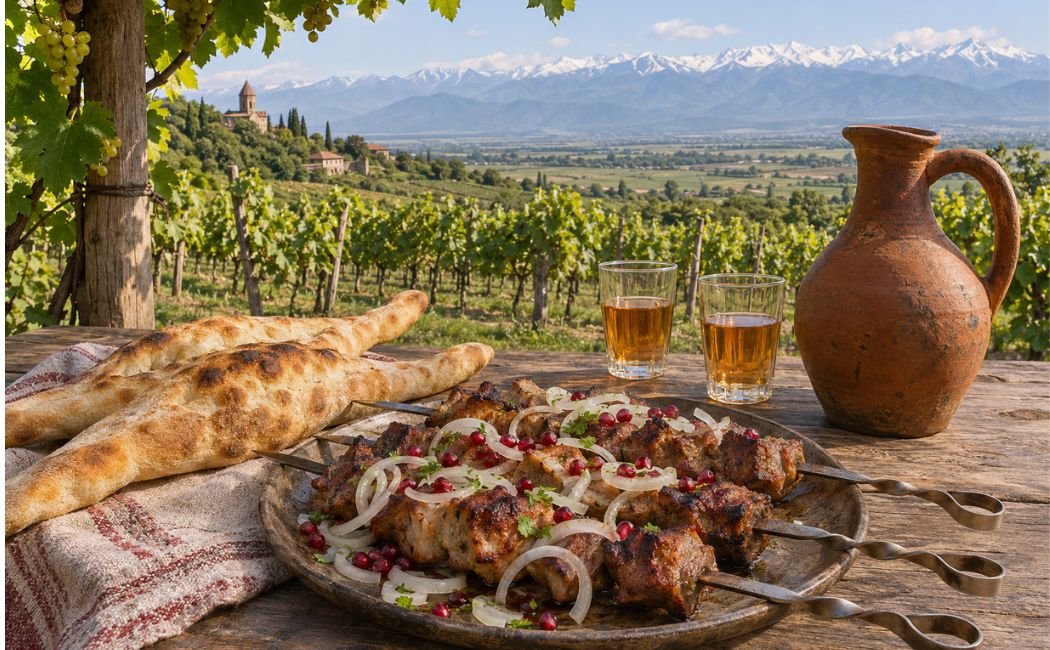
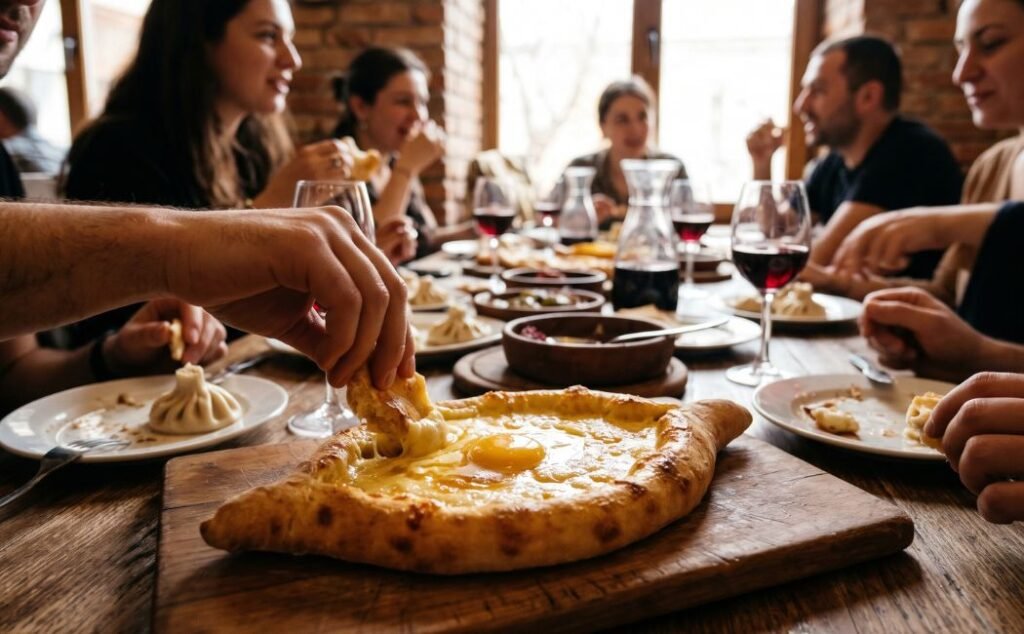
On your first night in Tbilisi, order a plate of khinkali. Pick up a dumpling by its thick dough knot and take a small bite to sip the broth inside. If you’re sharing dinner, add a warm khachapuri and tear off a piece while the cheese is still hot.
Set aside 40–120 GEL (about 15–45 USD) per person per day for food in Georgia. A bakery breakfast and a casual lunch can keep you near the lower end. If dinner means a few plates for the table and a glass of Georgian wine, budget closer to the upper end.
Here’s what to order from Tbilisi to the Black Sea coast, what you can expect to pay, and what to ask the kitchen if you have dietary restrictions.
How Much Does Food Cost in Georgia?
A casual restaurant meal in Georgia costs around 18–40 GEL (about 7–15 USD). Expect to pay more in busy areas like Old Tbilisi and central Batumi. If you’re watching your budget, check menus a few streets away from the main tourist spots.
Restaurant and Café Prices
| Item | Approx. price (GEL) |
| Khinkali (dumplings) | 1.30–3 each |
| Khachapuri (cheese bread) | 12–22 |
| Mtsvadi (grilled skewers) | 20–30 |
| Casual meal | 18–40 |
| Supra (Georgian feast) | 40–70+ per person |
| Coffee | 6–11 |
| Glass of wine or draft beer | 10–18 |
Khinkali are often priced by the piece. A November 2026 Tbilisi menu lists them at 2.90 GEL each, so five come to 14.50 GEL (about $5.35). If you want to try two fillings, ask whether the minimum order applies to each filling or to the whole order.
Before you order, check the bottom of the menu for a service charge. Some sit-down restaurants add 10–15%, so the final bill may be higher than the prices in the table.
Grocery and Market Prices in Tbilisi
| Grocery Item | Approximate Price (GEL) | Approximate Price (USD) |
| Shotis puri (1 bakery loaf) | 1.50–2.00 GEL | 0.55–0.75 |
| Milk (1 liter) | 5.70–7.00 GEL | 2.10–2.60 |
| Eggs (10–12 pack) | 7.00–8.50 GEL | 2.60–3.15 |
| Sulguni or Imeruli cheese (500 g) | 11–16 GEL | 4.10–5.90 |
| Chicken breast (500 g) | 8–10 GEL | 2.95–3.70 |
| Beef (1 kg) | 30–35 GEL | 11.10–12.95 |
| Tomatoes (1 kg) | 5–8 GEL | 1.85–2.95 |
| Apples (1 kg) | 4–5 GEL | 1.50–1.85 |
| Potatoes (1 kg) | 2–3 GEL | 0.75–1.10 |
If your rental has a kitchen, buy fresh produce, herbs, and cheese at open-air markets like Tbilisi’s Dezerter Bazaar rather than chain supermarkets. Prices drop noticeably for seasonal fruit and vegetables, and vendors let you taste cheeses before you buy.
Daily Food Budgets by Travel Style
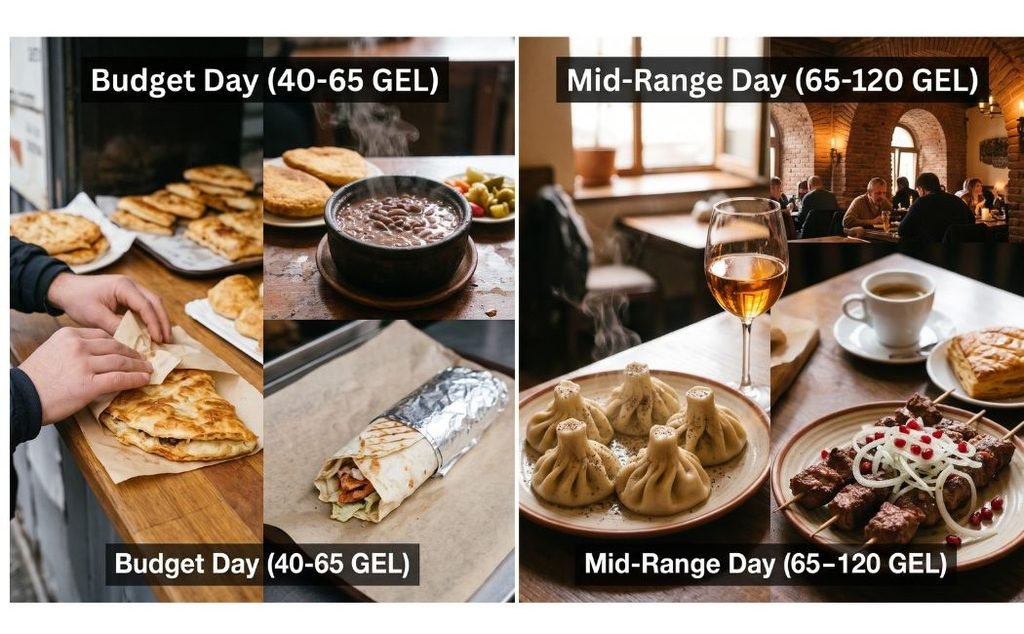
- Budget day | 40–65 GEL (15–24). Grab warm lobiani, a bean-filled bread, from a bakery for breakfast. Grab a shawarma for lunch, then order a clay pot of beans with cornbread for dinner.
- Mid-range day | 65–120 GEL (24–45). Start with coffee and a pastry. Try a few dishes at a traditional tavern for lunch and leave room in the budget for grilled meat and a glass of amber wine at dinner.
Monthly Grocery Budget in Tbilisi
If you’re staying in Tbilisi long enough to cook most meals, set aside 450–700 GEL (165–260) per month for groceries. Keep café visits and meals out in a separate budget.
Traditional Georgian Dishes to Try
Georgian meals center on shared plates rather than individual courses. Dishes arrive at the table as soon as they leave the kitchen, so order two or three items at a time.
From the Bread Oven
- Imeruli khachapuri: A round, flat yeast bread stuffed with salty, melted Imeretian cheese. Slice it into wedges and eat it warm.
- Adjaruli khachapuri: A boat-shaped bread filled with molten cheese, topped with a slab of butter and a raw egg yolk. Stir the yolk and butter briskly into the hot cheese as soon as it arrives, then tear off the pointed ends of the crust to dip inside.
- Shotis puri: A long, crescent-shaped loaf slapped onto the scorching interior wall of a deep clay oven called a tone. Buy it hot from basement bakeries for under 2 GEL and use it to mop up sauces.
Dumplings and Main Dishes
- Khinkali: Twisted soup dumplings stuffed with spiced pork and beef, mushrooms, potatoes, or cheese. When ordering meat khinkali, choose between kalakuri (city-style, mixed with fresh cilantro and parsley) and mtiuluri (mountain-style, seasoned simply with black pepper and cumin). Leave the thick top dough knots (kudi) on your plate; locals use them as handles rather than eating them.
- Mtsvadi: Chunks of pork, veal, or lamb skewered and grilled over dried grapevine embers. They arrive topped with thinly sliced raw onions and tart pomegranate seeds.
- Shkmeruli: Crispy pan-roasted chicken simmered in a sizzling clay pan of roasted garlic, milk, and butter.
- Chakapuli: A bright spring stew made with tender lamb or veal, white wine, sour green plums (tkemali), and heaps of fresh tarragon.
Vegetable Dishes Worth Ordering
- Badrijani nigvzit: Thin slices of fried eggplant rolled around a spiced paste of ground walnuts, garlic, vinegar, and blue fenugreek, finished with ruby pomegranate seeds.
- Pkhali: Minced spinach, beetroot, or green beans blended with walnut paste, herbs, and garlic into colorful, scoopable mounds.
- Lobio: Slow-cooked red kidney beans mashed with coriander, garlic, and savory herbs, served bubbling inside a clay pot (kotsi). Order it with pan-fried cornbread (mchadi) and a side of pickled vegetables (mzhavi).
- Ajapsandali: A hearty summer ratatouille of stewed eggplant, bell peppers, tomatoes, potatoes, and fresh basil.
Drinks and Sweets Not to Miss
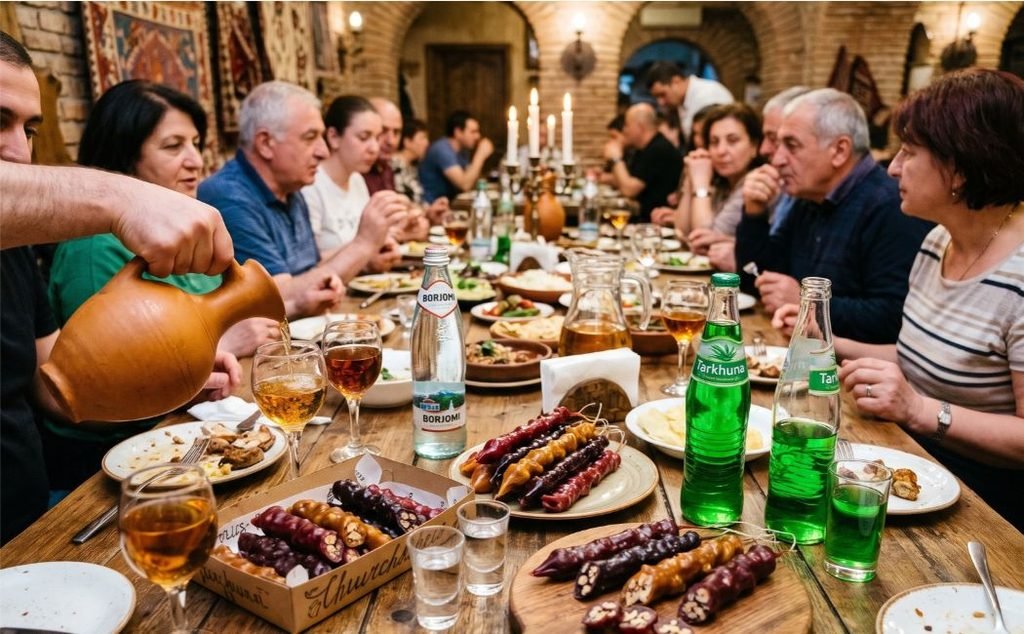
- Qvevri amber wine: Georgia has an 8,000-year winemaking tradition using large clay vessels buried underground. Ask for a glass of amber wine made from Rkatsiteli or Kisi grapes for dry, tannic notes of dried apricot and walnuts.
- Chacha: A potent, clear pomace brandy distilled from grape skins left over after winemaking. Locals drink it in small shots alongside toasted meals.
- Tarkhuna and Laghidze waters: Bright emerald-green tarragon lemonade (Tarkhuna) appears on almost every menu. In Tbilisi, visit Laghidze Waters to try sparkling water mixed with house-made syrups like cream, chocolate, and wild plum.
- Borjomi: Naturally carbonated, mineral-rich water from Georgia’s volcanic springs, famously used to settle the stomach after heavy feasts.
- Churchkhela: Often called “Georgian Snickers,” these candle-shaped sweets consist of walnuts or hazelnuts threaded onto a string and dipped repeatedly in boiled grape juice thickened with flour.
What to Eat in Tbilisi, Batumi and Beyond?
Look for custard-filled doughnuts in Tbilisi, boat-shaped cheese bread in Batumi, and spiced meat bread in Mestia. If you’re visiting several parts of Georgia, the local specialties give you a reason to order something different at each stop.
Tbilisi
For one evening, leave Meidan Square behind and look for a dukhan, a traditional tavern. Order kalakuri khinkali if you like herbs in your dumplings. If you’d rather have a stew, try ostri, made with beef simmered in a spicy tomato sauce.
Later, take the funicular up Mtatsminda for ponchiki. These fluffy fried doughnuts come filled with vanilla custard and are best eaten warm.
Batumi and Adjara
Start with Adjaruli khachapuri in the coastal city where the boat-shaped loaf originated. If you’re curious what else Adjara does with cheese, try borano, melted cheese with browned butter, or sinori, rolled dough sheets baked with fresh cheese and butter.
For a meal by the Black Sea, look for pan-fried red mullet or khamsi, small anchovies served crisp. If you visit Batumi’s central market, look for jars of chestnut honey.
Kakheti
Fresh shotis puri makes a good roadside stop on the way through Kakheti. For a longer lunch, order mtsvadi and ask whether the skewers are cooked over grapevine embers.
If you’re stopping at a cellar, try Saperavi, a deep red wine, or ask for an amber wine made in a qvevri, a clay vessel traditionally buried underground.
Samegrelo
Eat elarji while it’s hot. The sulguni cheese stretches as you lift a spoonful of the cornmeal. Megruli khachapuri has cheese inside the loaf and a golden layer baked on top.
For something different, order satsivi. The chicken is served cold in a thick walnut sauce.
Mestia and Svaneti
Pick up kubdari for lunch in Mestia. It’s a baked flatbread filled with chopped pork or beef and seasoned with spices and Svanetian salt. Ask which meat the bakery uses if you have a preference.
At dinner, look for tashmijabi. It starts with mashed potatoes, and once the sulguni is worked in, the potatoes stretch when you lift a forkful.
Vegetarian, Vegan and Halal Guide to Georgia
Georgia is straightforward to navigate on a plant-based diet, though travelers avoiding pork or animal rennet need to ask specific questions before ordering.
Vegetarian Options
- Walnut starters: Pkhali and badrijani nigvzit are naturally meat-free, protein-rich, and found on nearly every menu.
- Cheese breads and dumplings: Imeruli khachapuri, Megruli khachapuri, and mushroom or potato khinkali make filling mains. Note that traditional Georgian cheeses like Sulguni are made with animal rennet; if you avoid rennet, choose mushroom or potato fillings instead.
- Bean stews: Clay-pot lobio is vegetarian at most restaurants, though traditional taverns occasionally simmer it with lori (smoked pork ham). Always ask “Ukhortso?” (without meat?) before ordering.
Vegan Options
Georgian Orthodox Christians observe strict fasting periods throughout the year during which meat, dairy, and eggs are forbidden. Because of this tradition, restaurants and bakeries label fasting items as samarkhvo, and almost all of them are 100% vegan.
- Bakery lunches: Ask for samarkhvo lobiani (kidney bean-filled bread baked with vegetable oil rather than butter or lard) and plain shotis puri.
- Restaurant mains: Order ajapsandali, pkhali, badrijani nigvzit, plain ghomi (coarse cornmeal porridge without cheese), crispy mchadi cornbread, and pickled jonjoli (bladdernut sprouts).
- Desserts: Traditional churchkhela and pelamushi (firm grape-juice pudding) contain only grape juice, flour, and nuts.
Finding Halal Food
Pork is widely eaten in Georgia, and standard meat khinkali almost always combine minced beef and pork. Keep these steps in mind when ordering:
- Verify meat mixes: Ask specifically if khinkali, mtsvadi, or kupati (spiced sausages) are 100% beef or lamb, and confirm whether they are grilled on shared surfaces with pork.
- Look for halal certification: Tbilisi and Batumi both have dedicated halal restaurants, particularly around Marjanishvili Avenue in Tbilisi and central Batumi, serving Turkish, Middle Eastern, and halal-certified Georgian dishes.
- Plan ahead in the mountains: Certified halal meat is rare in mountain towns like Kazbegi (Stepantsminda), Gudauri, and Mestia. Rely on samarkhvo vegan dishes, fresh fish, or confirm dining options before leaving Tbilisi.
Money, Tipping and Ordering Tips
- Cash vs. cards: Restaurants, supermarkets, and coffee shops in Tbilisi and Batumi accept contactless credit cards and Apple/Google Pay. Carry small GEL bills and coins for neighborhood tone bakeries, open-air bazaars, and rural guesthouses.
- Tipping etiquette: If your receipt includes a 10% to 15% service charge, extra tipping is optional. If no service fee appears on the bill, leaving 10% in cash is appreciated.
- Tap water: Tap water in Tbilisi is generally safe to drink, though older buildings can have aging pipes, so many travelers prefer bottled mineral water like Borjomi or Bakuriani.
Frequently Asked Questions
Khachapuri (cheese-filled bread) and khinkali (broth-filled dumplings) are often considered Georgia’s national dishes. Every major region has its own version of khachapuri, with round Imeruli and boat-shaped Adjaruli being the two most popular varieties.
Yes. Georgian food is designed for family-style sharing, so a single order of khachapuri, lobio, or shkmeruli easily feeds two people. Order two or three dishes to share first, then add more if you are still hungry.
Order five khinkali as a main meal for one person. If you are sharing khachapuri, salad, or walnut starters with a group, two to three dumplings per person is plenty.
Georgian food is deeply aromatic rather than chili-hot. Dishes rely on fresh cilantro, tarragon, garlic, crushed walnuts, blue fenugreek, and marigold rather than burning heat, though spicy green adjika paste is often served on the side if you want extra kick.